Affichage des articles dont le libellé est carteret. Afficher tous les articles

23 février 2011

Côte des Iles: Carteret / Hotel Restaurant de La Marine


<< précédente      suivante >>

Petit matin sur la pointe et le port de Carteret, quand on ouvre les fenêtres de notre chambre.
------------------------

La Marine à Carteret est choyée par la famille Cesne depuis cinq générations.
Blanche, posée devant les flots au coeur de l'animation balnéaire du port de plaisance sur la côte ouest du Cotentin , elle abrite des trésors de convivialité et de gourmandise.

Laurent Cesne vous y présente toutes les saveurs de sa Normandie natale, entre terre et mer, terroir et créativité...

La salle à manger, avec sa vue panoramique sur le cap et la mer, offre aux convives une ambiance de classe dans un cadre digne des grands paquebots d'antan. Et la terrasse, telle l’étrave d’un grand voilier pointée vers les îles anglo-normandes , procure les sensations d’un départ en croisière...une traversée dont on ne voudrait jamais voir la fin!

Qualité technique, esthétique des présentations, parfums iodés renouvelés avec éclat, on ne peut rien reprocher à cette cuisine distinguée, naturelle et séduisante, où tous les plats sont exacts au rendez-vous du plaisir et de la bienséance.

Et en plus vous pouvez passer la nuit dans une chambre somptueuse. Que du bonheur!!


Early morning over the point and the harbor of Carteret, when we open the windows of our room at La Marine.
------------------------

La Marine at Carteret has been lovingly cared for by the Cesne family for five generations.
Dressed in white, anchored by the sea near the marina, on the western coast of the Cotentin peninsula, it offers real treasures of conviviality and great cuisine.

Laurent Cesne works with all the savors of his native Normandy, marrying land and sea, tradition and creativity.

The dining room, with its panoramic view on the cape and the sea, sends you back to the atmosphere of the great ocean liners of yesteryear. And the terrasse, like a tall ship pointing to the Channel Islands, makes you feel like you're leaving for an elegant cruise, and you'll wish it would never end.

Technical expertise, gorgeous presentation, the savors from the sea are recreated with class and you can only praise the chef's cuisine, natural and seductive, where every dish is a pleasure.

And, you can stay for the night in a somptuous room. Happiness guaranteed!!


For more information on Normandy, visit mynormandy.com

8 septembre 2010

Côte des Iles: La plage d'Hatainville


<< précédente      suivante >>

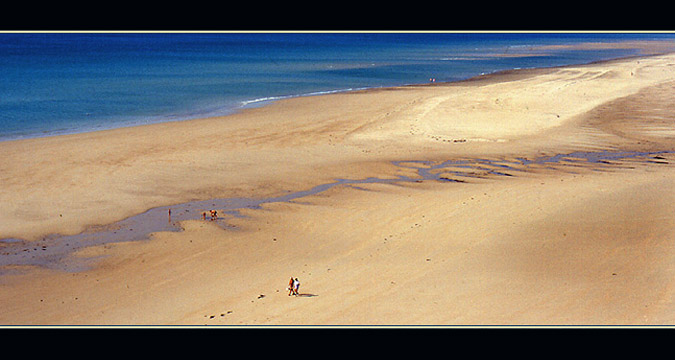
Immense et déserte, la plage d'Hatainville s'étend du pied de la pointe de Carteret jusqu'à l'horizon.
------------------


Les dunes d'Hatainville sont presque intégralement situées sur le territoire des Moitiers d'Allonne, commune étendue, de faible population et en grande partie bocagère et agricole. Le site dessine approximativement un rectangle d'environ 5 km sur 1,5 km.

Le massif dunaire d'Hatainville atteint 80 m d'altitude au maximum. Il s'appuie sur une falaise fossile qu'il a en partie nappée. Cette formation de " dunes perchées " est l'une des plus spectaculaires en Europe. Elle est le résultat de l'histoire géologique et climatique armoricaines et notamment de la remontée progressive du niveau marin consécutive à la dernière glaciation.

Les paysages dunaires marquent une lente évolution vers le bois, comme on le voit ici à Hatainville:

Le haut de plage regroupe une végétation éparse composée d'espèces annuelles résistant aux embruns et recherchant les endroits riches en nitrates provenant des algues.

La dune embryonnaire et la dune vive accueillent une végétation pionnière, s'implantant dans des conditions difficiles. L'Elyme des sables trouve ici l'une de ses dernières stations vers le sud et l'ouest. Cette plante protégée au plan national est accompagnée du Liseron des sables, de l'Euphorbe, du Pourpier des mer, etc... L'oyat, plante typique de la dune vive, demeure l'espèce fixatrice majeure de la dune bordière accompagnée de la Fétuque, du Chardon bleu des dunes et de l'Euphorbe.

Les landes à fougère aigle occupent les retombées des dunes perchées. Cette plante est considérée sur le site par certains chercheurs comme une relique forestière, préfigurant le stade boisé. La fougère se maintient grâce à son rhizome profond. Le bétail refuse également de la pâturer.

Les fourrés dunaires sont constitués du prunellier, du troëne, de l'aubépine, de la ronce, de l'églantier et de l'ajonc. Ils représentent une transition entre le stade herbacé et la zone arborée. Les fourrés s'abritent dans les dépressions (pannes), en retrait de l'actuelle ligne de rivage ou au pied de la falaise fossile. Les dépressions les plus humides abritent le saule roux-cendré en forte densité.

Des cyprès de Lambert ont été plantés en guise de brise-vent, mais les pins noirs constituent un boisement original sur la hauteur dominant la partie méridionale du site.


Immense and deserted, the beach at Hatainville stretches from the foot of the point of Carteret to the horizon.
------------------

The dunes of Hatainville are almost completely located in the municipality of Les Moitiers d'Allonne, sparsely populated, and occupy a rough rectangle 0r 3 miles by 1 mile.

The dunes reach a height of 250 feet, as they climb up an ancient cliff. They form the most spectacular area of such "suspended" dunes in Europe.

The landscape at Hatainville shows a slow evolution toward the forest:

Just above the beach, the vegetation consists of a few species that resist the salty air and that can survive in pockets rich in nitrates from decomposing algae.

Furthere up, dune grasses fix the sand in place. Along the slopes of the ancient cliff, ferns have established themselves. With their deep rhyzomes, they can reach out for water deep below the surface. In the depressions, some low bushes manage to take root and thrive. When water is near the surface, willows appear in dense thickets.

Lambert cypresses have been planted to protect the dunes from the wind, but the natural environment on higher ground consists of pine trees, especially on the southern slopes of the site.


For more information on Normandy, visit mynormandy.com

12 mai 2010

Côte des Iles: La plage d'Hatainville / Régates


<< précédente      suivante >>

Du haut de la falaise de la pointe de Carteret, la plage d'Hatainville semble s'étendre jusqu'à l'horizon. Et en dehors des weekends d'été, elle est toute à vous!
-----------------------

Deuxième weekend de compétition pour les bras forts des clubs d'aviron de la région: La Régate de la Côte des Iles, qui a eu lieu samedi dernier (8 mai).
Le parcours longe la côte entre le Cap de Carteret et la cale de St-Georges-la-Rivière, pour une distance de 8 miles nautiques. Beaucoup plus courte donc que celle de la semaine dernière à Barfleur. Mais les résultats sont les mêmes:
Lohier, Mauger, Juge, Cochelin ont remporté l'épreuve en 37m 10s, devant Renouf, Bocage, Leriche, Lebas, à 1 minute et demi derrière. Chez les dames, victoire de Palmiéri, Hamon, Juge, Salignière en 43m 34s.
Thomazo, Renouf, Schieffer, Desjardins ont gagné le trophée Cadets en 48 minutes.


From the top of the cliffs at the Point of Carteret, the beach of Hatainville stretches to the horizon. And outside of the summer weekends, it all yours!

-----------------------

Second week-end of races for the strong arms of the rowing clubs of the region: The Regatta of the Côte des Iles, which took place last Saturday (May 8th) at Carteret.
The race runs from the Cape of Carteret to the boat ramp at St-Georges-la-Rivière, 8 nautical miles away; a race much shorter than last week's regatta at Barfleur.
But the results are the same:
Lohier, Mauger, Juge, Cochelin won in 37:10, in front of Renouf, Bocage, Leriche, Lebas, a minute and a half behind. The women's race was won by Palmiéri, Hamon, Juge, Salignière in 43:34, and Thomazo, Renouf, Schieffer, Desjardins took the junior competition in 48 minutes.


For more information on Normandy, visit mynormandy.com

31 décembre 2009

Côte des Iles: La plage d'Hatainville / La Famille Carteret


<< précédente      suivante >>

De la pointe de Carteret, au pied du phare, la plage d'Hatainville s'allonge jusqu'à l'horizon, immense et déserte...Invitation à la promenade.

-------------

Pierre de Carteret était le cousin du Propriétaire des Carolines, Georges de Carteret. Nommé Gouverneur Adjoint et Secrétaire d'Albemarle en Décembre 1664, Pierre arrive dans la colonie américaine le 23 Février 1665.

Sa vie ressemble plutôt à celle d'un paysan, loin de l'image qu'on peut se faire de la vie d'un gouverneur d'un territoire immense. Ses premières années à Albemarle illustrent la vie des premiers colons de la région. Mais en plus de ses functions de gouvernement, il devait gérer la plantation de Colleton Island, qui en 1665 consistait principalement de quelques champs, d'une maison de 7 m. de long et d'un abri pour les cochons.

Pendant 7 ans, le Gouverneur Adjoint travaille la terre, trop souvent proche de la famine.

Ouragans, sécheresse, inondations dévastent les récoltes en 1667, 1668 et 1669. Même l'industrie de l'huile de baleine, que Carteret avait débuté avec un certain succès, succomba à l'absence des baleines le long des côtes en 1669.

Telle était la situation quand le Conseil de la Colonie, le 10 Mars 1670, confirma Carteret comme Gouverneur d'une région où "il a plu à Dieu dans sa providence d'infliger une telle calamité sur tous ses habitants qu'ils n'ont pas pu jouir des fruits de leur travail depuis plusieurs années." Albemarle était au bord de la pauvreté et de la famine.

Au début de son administration, Carteret reçut les Constitutions Fondatrices des Carolines, qui, déclaraient le propriétaires, était inaltérable. Les citoyens d'Albemarle craignaient que cette constitution semerait les germes d'une aristocratie locale, les habitants étant réduit au rang de serfs.

En plus, une rumeur circulait q'une nouvelle colonie allait être établie dans le sud des Carolines et qu'elle deviendrait le siège du gouvernement.

Bien qu'assurés que les représentants du peuple auraient un certain pouvoir, c'était en fait le Grand Conseil qui, comme indiqué par la Charte, avait le seul droit de proposer eet de voter les lois.

La discorde monta à un tel niveau qu'en 1672 le Conseil décida d'envoyer Pierre de Carteret à Londres pour présenter leurs doléances aux Propriétaires.

Parmi celles-ci, la superficie minimum de 4.000 hectares pour toute propriété agricole, imposée par la Constitution, était considérée comme nuisant à l'expansion de la colonie.

Le Conseil envoya aussi un avertissement contre les stratagèmes des habitants de Virginie, qui voulaient absorber leur colonie et qui essayaient de controler le prix du tabac exporté par les ports de Virginie.

Avant son départ, Carteret donna à John Jenkins, President du Conseil et Lieutenant-Colonel de la milice, tous les pouvoirs du Gouverneur.

Carteret espérait revenir à Albemarle, mais il resta en Angleterre.

D'après Peter Colleton, Carteret aurait fui la Caroline, ayant laissé le gouvernement en mauvais état. Toutefois, ces critiques sont sans doute venues des propriétaires, essayant de justifier leur négligence et manque de vision pour le dévelopement de la colonie et de faire passer Carteret comme responsable des problèmes à Albemarle.

If faut se rappeler que Carteret était non seulement Gouverneur de la Colonie, mais aussi responsable de la plantation de Colleton Island. En plus de la création de l'industrie de l'huile de baleine, il devait aussi promouvoir la production de sucre, de soie et de vignes.

Néanmoins, l'Albemarle que Pierre de Carteret quitta en 1675 était proche de la révolte, révolte qui explosa deux ans plus tard et qu'on se rappelle comme la Rebellion de Culpepper.

-------------------------------------------------------


From the Cape of Carteret, at the foot of the lighthouse, the beach of Hatainville expands all the way to the horizon, wide and deserted....perfect invitation to a long hike.

-------------------


Young Peter Carteret was a cousin of the Proprietor of the Carolinas, Sir George Carteret. Appointed Assistant Governor and Secretary of Albemarle in December, 1664, Peter Carteret landed in the colony February 23, 1665.

Carteret's life followed more closely that of a farmer than that of the traditional picture of an executive. Indeed, his years in Albemarle illustrate rather graphically the lives of the early Carolina settlers. In addition to his governmental duties, he was charged with the operation of the plantation on Colleton Island, which in 1665 consisted of little more than some cleared land, "a 20 foot dwelling howse [and] a 10 foot hogg howse."

For the next seven years the Assistant Governor of Albemarle grubbed in the soil, at times approaching dangerously near to starvation.

On August 27, 1667, a hurricane ripped through the colony just at harvest time. The following year the burning, bright sun of a drought crisped the crops until July 30. Then nature, in one of her more capricious moments, opened her heavens to soak the parched earth with rain until the last of August, thereby doing more damage than had the long dry spell.

Misery compounded itself when on August 2, 1669, in the midst of the tobacco harvest, another violent hurricane brought ruin. And just four days more than a year later, on August 6, 1670, the winds rose to new heights as still another hurricane levelled crops and houses. Even the whale oil industry, which Carteret had been developing with some success, fell off, for in 1669 the mammals no longer came in close to the shore.

Such was the situation when the Council, on March 10, 1670, confirmed Casrteret as governor of an area where "it hath pleased God of his providence to Inflict Such a Generall calamitie upon the inhabitans of these countreys that for Severall yeares they have Nott Injoyed the fruitts of their Labours." Albemarle had reached the bitter edge of poverty and famine.

Early in Carteret's administration came the first word of the Fundamental Constitutions of Carolina, which, declared the Proprietors, "Shall be unalterable." The flame was fanned, as murmurings crept among the people that within this new frame of government lay the germs for a self-erected aristocracy, with the general population reduced to little more than the level of feudal serfs.

An additional cause for apprehension lay in the information that a new colony was to be seated in the southern part of Carolina, and destined to become the primary center of government.

Although the people were assured they were to have a voice in the government, as required in the Charter, the Proprietors maintained a check on their legislative programs through the appointment of deputies to represent them on the Grand Council. And it was the Grand Council, not the Assembly made up of representatives of the people, who retained the right to propose, or initiate, all legislation.

Discontent was so evident in early 1672 that the Council felt it necessary that Governor Carteret and his Assistant, John Harvey, travel to England to lay their grievances before the Proprietors.

The laying out of land in 10,000 acre plots as outlined in the Fundamental Constitutions the Council considered to be both impracticable and a deterrent to future settlement. They included a warning against "the Juglinge devices & Stratagemes" of those in Virginia who were attempting to bring Albemarle within the jurisdiction of that colony and who were already discriminating against Carolina tobacco being shipped through Virginia ports."

The Council explained that Carteret, "by whose prudence and Integrity God hath blessed us since receiving that charge," was being dispatched to London, accompanied by Harvey, for this personal representation would be almost "as if wee had had ye conveneince & happiness to have Spoken Man by Man to your Lordshipps."

Before his departure Carteret issued to John Jenkins, President of the Council and Lieutenant-Colonel of the Albemarle militia, a commission endowing him with all of the power of Governor.

Carteret entertained the hope that he would eventually return to Albemarle as the colony's secretary, but he never did. Much has been made of Peter Colleton's statement that Carteret had fled Carolina, "having left ye Government there in ill order & worse hands." This unwarranted accusation seems to have been an attempt by the Proprietors to justify their own neglect and shortcomings in the development of Albemarle and to brand Carteret as the goat for all of the later troubles and unrest in Albemarle.

In Carteret's defense, it should likewise be remembered that in addition to his executive position, he was charged with the responsibility of making a financial success of Colleton Island. Similarly, he was under constant pressure not only to develop the whaling industry, but to promote the more exotic and profitable products of sugar, silk, and vineyards.

Nevertheless, the Albemarle of Peter Carteret was a simmering cauldron of unhappy people, dissatisfied with their present and apprehensive of their future. In such a situation the seeds of discontent and rebellion can always find fertile soil.

11 mars 2009

Carteret: La Pointe et la Digue


<< précédente      suivante >>

On peut faire la promenade de la pointe de Carteret, du phare jusqu'au port, des dizaines de fois, sans ne jamais voir le même paysage, qui change suivant l'heure, les marées, le ciel....
------------------------------

On avait commencé l'histoire de la famille Carteret lors du dernier acticle sur le site de Carteret. On saute quelques siècles, et on arrive à Georges de Carteret et pourquoi, dans le New-Jersey, on trouve une ville nommée Carteret.

Né à Jersey en 1609, Georges de Carteret en devient gouverneur en 1643. Pendant la Révolution anglaise, il reste allié avec la famille royale contre le Parlement. Après l'éxécution de Charles 1er, c'est à Jersey que Charles II est proclamé roi avant de s'exiler en France.
Chassé de Jersey en 1651, Georges se réfugie à Paris, où il devient amiral de la flotte française, et lutte contre l'Espagne, puis contre l'Angleterre de Cromwell.
En 1654, son exil n'en finissant pas, il achète les manoirs de Potrel et de la Provostière dans le Cotentin, revenant ainsi à ses racines normandes.
En 1660, Charles II rentre en vainqueur en Angleterre et Georges de Carteret est à ses côtés. Pour son service et sa fidélité le roi lui donne le New-Jersey, 1/8 des Carolines, et 1/6 des Barbades.
Accusé en 1667 d'erreurs administratives et de détournement, il est exilé dans sa colnie du New Jersey de 1669 à 1673. Il en profite pour mieux l'organiser , avec l'aide de son cousin Philippe de Carteret, nommé Gouverneur. Ils fondent les villes d'Elizabeth Town, Jersey City, et Carteret.
En 1673, le Parlement annule l'accusation et Georges rentre en Angleterre, où il décédera en 1679.

------------------------------------------------------


We have hiked around the point at carteret, from the lighthouse to the harbor, dozen of times. And we never see the same landscape, the sky is different, the tide is coming in or going out, and the light changes from hour to hour.
------------------------------

We first talked about the Carteret family in the last post of a Carteret seascape. We now jump a few centuries, to Georges de Carteret and why, in the state of New-Jersey, there is a town named Carteret.

Born in Jersey in 1609, Georges de Carteret became governor of the island in 1643. During the English revolution, he stood by the royal family against Parliament. After the execution of Charles the 1st, it is in Jersey that Charles the 2nd is crowned King of England before being exiled to France.
Georges was driven out of Jersey in 1651 and found refuge in Paris, where he became admiral of the French Navy. He waged war first against Spain, then against Cromwell's England.
In 1654, his French exile dragging on, he bought two estates in Normandy, the manors of Potrel and la Provostière dans le Cotentin, comimg home to his ancestral roots.
In 1660, Charles II came back to England, Georges de Carteret at his side. For his service and loyalty, the king offered him New-Jersey, 1/8 of the Carolinas, and 1/6 of Barbados.
Accused of profiteering in 1667, he was exiled to New Jersey. He spent the next few years reorganizing the colony, with his cousin Philippe de Carteret, who he named governor. Under their administration were born the cities of Elizabeth Town, Jersey City, and Carteret.
In 1673, Parliament voided the accusations and Georges returned to England, where he died in 1679.

17 août 2008

Carteret, la Plage à marée basse


<< précédente      suivante >>

La promenade sur le sentier du littoral à Carteret offre de belles vues sur la mer et les plages.

Nous sommes partis du sémaphore, tout en haut du Cap de Carteret, pour revenir vers le village. Au détour du chemin, la vue vers le sud s'ouvre lentement sur la plage de Carteret, où la digue s'avance tout droit vers la mer, et où gisent des bancs de sable abandonnés par la marée descendante.

------------------------------------------------


La famille des Seigneurs de Carteret remonte au Xe siècle: Guy de Carteret serait né vers 960 et aurait vécu jusqu'en 1004. Ses petits-fils, Onfroy, Mauer et Roger, auraient participé à la Bataille d'Hastings avec Guillaume le Conquérant. Le fils d'Onfroy, Renaud I, ajouta l'ile de Jersey à ses possessions.

Au début du XIIIe s.,Renaud III perdra ses terres en Normandie après avoir choisi le camp de Jean Sans Terre, roi d'Angleterre, contre le roi de France, Philippe-Auguste. Son petit-fils, Philippe IV, lui, se range contre les Anglais avec le roi Philippe III de France, qui lui restitue ses terres Normandes.

En 1329, la famille perd à nouveau son domaine de Carteret, et devra dorénavant se contenter des iles Anglo-Normandes.

------------------------------------------------


On a hike on the path that follows the shoreline, starting at the lighthouse at the top of the Carteret Point, the views open up on the beach as we approach the town.

The jetty juts towards the sea, and long sand banks lie abandonned by the receding tide.

------------------------------------------------


The Carteret family goes back to the 10th c.: Guy de Carteret was born around 960, and died around 1004. His grandsons, Onfroy, Mauer and Roger, fought with William at Hastings. Onfroy's son, Renaud I, took over the island of Jersey, just offshore from Carteret.

At the beginning of the 13th c., Renaud III lost his domain on the Normandy mainland after siding with John Landless against the king of France, Philippe-Auguste. His grandson, Philippe IV, switched sides and supported Philippe III of France, who gave him back his lands.

But in 1329, the family lost them again, and from now on, the Carterets' domain will be the Channel islands.

22 juin 2008

Le Cap de Carteret


<< précédente      suivante >>

Du haut de la falaise du cap de Carteret, au pied du phare, en suivant le sentier qui retourne vers le village, on découvre, à marée basse, un long ruban de plage dorée qui s'étend jusqu'au havre qui sépare Carteret de Barneville.

Situé au sud de la Hague, le cap de Carteret est le dernier des grands caps rocheux du Cotentin jusqu’à Granville.

-------------------------------------------------


From the top of the cliff at Carteret, just below the lighthouse, we took the trail that meanders back to the village. It was low tide, and a long ribbon of honey-colored sand unwound at the foot of the black rocks of the cape, all the way to the narrow bay that separates Carteret from Barneville.

Jutting into the sea at the south end of the Hague, the cape of Carteret is the last of the rocky spurs until Granville.