Affichage des articles dont le libellé est omaha beach. Afficher tous les articles

27 janvier 2012

Omaha Beach: Les Braves/ Hotel L'Hostréiere


<< précédente      suivante >>


Nouveau regard sur l'oeuvre d'Anilore Banon sur la plage à Omaha Beach. Ça pince toujours le coeur!

---------------------------

C'est à Colleville sur Mer, a deux pas du Cimetière Américain et de la Plage du débarquement d'Omaha Beach que Véronique et Patrick LE NOTRE vous accueillent dans leur hôtel au cœur du Bessin dans un cadre chaleureux.

L'Hostréiere c'est 19 chambres de belle facture, spacieuses et confortables au coeur d'une ancienne ferme du bessin, et c'est aussi la Résidence "Les Poppies" avec des appartements spacieux tout équipés alliant modernisme et qualité à louer à la semaine, le tout dans un parc arboré fermé et sécurisé. Vous pourrez vous relaxer autour de la piscine chauffée, de mai à fin septembre , vous restaurer le midi au lunch café ou au salon de thé.


A new image of Les Braves, Anilore Banon's sculpture on the sand at Omaha Beach.

---------------------------

In Colleville sur Mer, just outside the American Cemetery and close to the landing beaches at Omaha Beach, Véronique and Patrick LE NOTRE welcome you in their quiet hotel nestled in the countryside.

L'Hostréiere offers 19 large and comfortable in an ancient farm typical of the region, and several roomy apartments in the Résidence "Les Poppies" if you want to spend a week in Normandy. You can walk around the large garden surrounded by high stone walls, relax by the heated pool, or enjoy your lunch or afternoon tea in the tea-room.


For more information about Normandy, visit MyNormandy.com

16 octobre 2011

Omaha Beach: Epave / Philippe Leclerc, photographe

<< précédente      suivante >>


Voilà quelques années, il y avait encore une épave sur la plage de Vierville, une péniche en béton; remorquée depuis l'Angleterre et coulée pour briser les vagues et protér le port artificiel.
------------------------------


Philippe Leclerc est originaire de Caen. Photographe professionnel, né en 1963, il pratique la photographie depuis 25 ans essentiellement en noir et blanc. Son style se caractérise par la sobriété des motifs, la rigueur des compositions, le raffinement de la lumière.
Il a ouvert Le Temps Suspendu à Bayeux, sa galerie à Bayeux, au coeur du centre historique de la ville, à deux pas de la Cathédrale et de la Tapisserie.
Ses travaux y sont présentés tout au long de l'année, y compris une très belle collection sur les plages du Débarquement.


Some years ago, there was still a shipwreck from Word War II on the beach at Vierville, a concrete barge towed across the English Channel and sunk near the D-Day landing beach to provide a wavebreaker for the artificial harbor.
------------------------------


Philippe Leclerc was born in Caen in 1963 . He has practiced his craft and art as a professionnal photographer for 25 years, mainly in black and white. His style is characterized by the simplicity of his subjects, strong compositions, and a refined use of the light.
Recently, he opened a gallery in Bayeux, Le Temps Suspendu, right in the historic center of the city, near the cathedral and the Tapestry.
He exhibits his photographs there year round, including a wonderful collection on the D-Day beaches.


For more information about Normandy, visit MyNormandy.com

23 septembre 2011

Omaha Beach: Les Braves / Ferme de la Sapinière

<< précédente      suivante >>

Une autre vue de l'oeuvre monumentale d'Anilore Banon sur la plage de St-Laurent-sur-Mer.
-----------------------

On vous a déjà parlé de la Ferme de la Sapinière à St-Laurent-sur-Mer.

If faut y revenir maintenant que Michel et Philippe Legallois ont reçu la medaille d'or au Concours Général Agricole 2011 pour leur Pommeau de Normandie AOC de 2 ans et pour leur jus de pommes.


Another view of the monumental sculpture by Anilore Banon on the beach of St-Laurent-sur-Mer.
-----------------------

We already told you about the cider, pommeau and calvados of the farm at La Sapinière.

We have to go back again now that Michel and Philippe Legallois have won Gold medals at the 2011 farm products Competition for their 2 year old Pommeau and their apple juice.

For more information about Normandy, visit MyNormandy.com

14 juillet 2011

Omaha Beach: Les Braves /Randonnées de la paix

<< précédente      suivante >>

Sur la plage de Saint-Laurent-sur-Mer, l'oeuvre monumentale d'Anilore Banon, les Braves, est devenue un des haut-lieux commémoratifs du Débarquement.
--------------------


La troisième édition des «randonnées de la paix» aura lieu le dimanche 17 juillet 2011 des Plages du Débarquement au Mémorial de Caen.

Les « randonnées de la paix » sont organisées en mémoire de la Libération de la ville de Caen le 19 juillet 1944.

Au départ des plages de la Côte de Nacre, « Juno Beach » et « Sword Beach » ainsi que de la zone affectée à la VIème Airborne à Merville-Franceville ou de « Gold Beach », vous partirez sur les traces des Canadiens, des Britanniques, ou encore des Commandos Français, en direction du Mémorial de Caen.

Cette journée sera l'occasion pour les randonneurs de (re)découvrir l'histoire et les événements qui se déroulèrent ici en 1944 et qui furent fondateurs de la Paix en Europe.

Les plages de la Côte de Nacre furent en effet le lieu du débarquement des Canadiens, des Anglais et des Commandos français. C'est à Bénouville-Ranville que tout a commencé dans la nuit du 5 au 6 juin, avec la libération du célèbre Pegasus Bridge, premier pont libéré de la France continentale. C'est à Merville-Franceville que le 9ème Bataillon prit d'assaut la batterie allemande et d'Arromanches à Asnelles que fut construit le port artificiel.
Le même jour plus à l'ouest, les américains débarquaient également.

Sur les trajets, des témoins de l'époque ou des historiens vous parleront de ces événements !

Tout au long des itinéraires, vous découvrirez musées, stèles, vestiges du Mur de l’Atlantique, cimetières militaires... autant de lieux pour se souvenir de cette histoire tragique.

Quinze départs et distances différentes vous sont proposés pour vous permettre de choisir la randonnée qui vous convient : à pied, à vélo, en V.T.T. en rollers, en marche nordique ou à cheval.

Pour tous renseignements: http://www.randonnees-normandes.com/fr/accueil-t2.html


On the beach at Saint-Laurent-sur-Mer, the monumental sculpture by Anilore Banon, les Braves, has become a symbol among the commemorative sites of the D-Day landings.
--------------------


The 3rd edition of the «Hikes for Peace» takes place on SUnday, July 17, from starting points on the D-day Beaches to the Mémorial Museum in Caen.

The « randonnées de la paix » are a commemoration of the liberation of the city of Caen on July 19, 1944.
Starting from Juno Beach, Sword Beach, Gold Beach and from the paratroopers landing area of Merville-Franceville, you will retrace the footsteps of the Canadian or British soldiers, or of the French Commandos, toward the Mémorial in Caen.

This will be the chance to (re)discover the history of D-Day and the events of 1944, precursors of Peace all over Europe.

It is on these beaches that the Canadians, the British and the French landed. D-Day started in Bénouville-Ranville with the capture of Pegasus Bridge. And it is at Merville-Franceville that the 9th Battalion took the powerful German battery that threatened the sea landings. Arromanches and Asnelles are the sites of the artificial harbor.
Along the way, witnesses to these events and historians will explain what happened that fateful day.

And you will discover museums, plaques, monuments, bunkers of the Atlantic Wall, and military cemeteries.

Fifteen starting points are scheduled. Depending on your itinerary, you can wilk, ride a bike or a horse, or even use your rollers.

More is available at: http://www.randonnees-normandes.com/fr/accueil-t2.html


For more information about Normandy, visit MyNormandy.com

3 juin 2011

Plages du Débarquement: Les Braves / Cérémonies du 6 Juin

<< précédente      suivante >>

Sur la plage de St-Laurent-sur-Mer, l'oeuvre monumentale d'Anilore Banon nous rappelle ce qui se passa ici voilà 67 ans.
--------------------

Dimanche 5 Juin: 10h - 13h.: Pour la 3ème année consécutive, le Yankees organisent, avec le précieux concours de la commune de Saint-Laurent-sur-Mer, la cérémonie Omaha’s Nurses Return en l’hommage des femmes qui se sont engagées dans le second conflit mondial.
Leur contribution discrète et souvent oubliée, a pourtant été un rouage indispensable à la machine de guerre alliée.
Résistantes, combattantes, ouvrières, mères de famille, toutes ont donné de leur temps et de leur énergie et cette année encore, nous aurons une pensée pour elles lors de cette cérémonie émouvante unique en France.
En leur mémoire, les participantes en uniforme se réuniront autour du monument "les Braves" avant d’aller déposer ensemble une fleur à la mer.
Le rassemblement débutera, cette année, 30 minutes avant le début de la cérémonie.
Merci de venir munie d’une fleur de votre choix.

Vous pouvez trouver le programme complet des cérémonies ici .


On the beach of Omaha beach, the monumental sculpture, The Braves, by Anilore Banon, reminds us of what happened here 67 years ago.
--------------------

Sunday, June 5 · 10:00am - 1:00pm: For the third consecutive year, the Yankees hold, with the invaluable assistance of the commune of Saint-Laurent-sur-Mer, the ceremony "Omaha's Nurses Return" in honor of the women who are involved in the Second World War.
Their contribution discreet and often forgotten, however, has been an indispensable cog in the Allied war machine.
Resistant fighters, workers, mothers, all donated their time and energy and this year we will have a thought for them during this moving ceremony unique in France.
In their memory, participants in uniform will gather around the monument "the Braves" before going to file a flower all at sea
The rally will start this year, 30 minutes before the ceremony.
Thank you for coming equipped with a flower of your choice.

You can find the complete program of this year's ceremonies here.

For more information about Normandy, visit MyNormandy.com

14 avril 2011

Omaha Beach: Au Cimetière Américain /Chambres d'Hôte Au Château St-Pierre

<< précédente      suivante >>

Juste au-dessus de la plage si tranquille de Colleville-sur-Mer, les croix du cimetière américain s'alignent à l'infini, vagues de soldats venus de la mer.

------------------

Juste entre Omaha beach et la Pointe du Hoc, vous ne pouvez pas manquer le Château de St-Pierre avec son portail orné d'une tour à machicoulis surmonté d'un pigeonnier.

Le château date du XVIe s.

A la fin du XVIIIe s., il passe par mariage dans la famille De Frotté, rendue célèbre par Louis De Frotté, qui émigra en Angleterre après la mort du roi et retourna en 1794 pour diriger l'Armée Catholique et Royale de Normandie contre la nouvelle République. Mais en 1796, les forces françaises, sous le commandement du Général Hoche soumettent les Chouans et Louis De Frotté se réfugie à nouveau en Angleterre. Là, le Comte d'Artois, frère de Louis XVI, lui demande de commander une nouvelle rebellion en Normandie.

Il connut quelque succès, mais Napoléon Bonaparte, promu Premier Consul, écrase la Chouannerie. In 1800, Louis De Frotté essaie de négocier avec le gouvernement, mais il tombe dans un piège, est arrêté et trois jous plus tard, condamné à mort et éxécuté, le 18 février 1800.

Mais aujourd'hui, rien ne transpire de cette histoire au Château de St-Pierre, où Jean et Marie-José Beck seront heureux de vous offrir cinq chambres avec meubles anciens, tapis d'Orient et poutres apparentes.


Just above the peaceful beach of Colleville-sur-Mer, the crosses of the American Cemetery in Normandy form endless rows, like waves of soldiers emerging from the sea.

------------------


Just between Omaha Beach and the Point du Hoc, you cannot miss the Château de St-Pierre: It simply rises out of the road as you head along the coast. Its entrance gate, flanked on the right by a machicolated defensive tower, is typical of the fortified gates which guarded many Norman manors. The upper part of that tower once housed a dovecote, which was a symbol of nobility until the Revolution.


St. Pierre-du-Mont Castle dates back to the 16th century. At the end of the 18th century it passed through marriage to the De Frotté family. Its most famous member was Louis De Frotté, who emigrated to England during the French Revolution and came back in 1794 to lead the Catholic and Royal Army of Normandy against the new French Republic.

By 1796, however, French forces under General Hoche had defeated the Chouans and forced De Frotté to flee. Returning to England, he was enlisted by Charles, Count of Artois (King Louis XVI's brother), in an attempt to start yet another rebellion in his native Normandy.

This rebellion was fairly successful, but, after Napoleon Bonaparte seized power, the tide began to turn against De Frotté. In 1800, he tried to negotiate with the government, but was lured into a trap, arrested and, three days later, brought before a military tribunal, which sentenced him to death. He was shot on February 18.

Today, this little bit of history is forgotten, and at the Château de St-Pierre, où Jean and Marie-José Beck run a luxurious bed-and-breakfast with five grand rooms with antique furniture, oriental rugs and coffered ceilings.


For more information about Normandy, visit MyNormandy.com

26 janvier 2011

Omaha Beach: Les Braves / Chambres d'hôte Au Manoir de Vaumicel


<< précédente      suivante >>

Un autre regard sur Les Braves, la sculpture monumentale d'Anilore Banon, par une belle journée ensoleillée.
------------------------

Pour passer une nuit dans un manoir de conte de fées, allez au Manoir de Vaumicel, où Valérie de Bellaigue vous accueille dans sa belle demeure du XVIe s.
Votre chambre claire, avec sa belle armoire normande et son plafond très haut, se situe dans une des ailes du manoir et est flanquée de deux tourelles où se nichent la salle de bains et deux petites chambres.
Et vous serez à deux pas de la Pointe du Hoc et de Omaha Beach.


Another look at Les Braves, the monumental sculpture by Anilore Banon, on a sunny afternnon.
------------------------

To spend a night in a fairy-tale chateau, go to the Manoir de Vaumicel, where Valérie de Bellaigue will welcome you in her 16th c. house.
Your room, bright and cheerful, with its antique Normandy armoire and its high ceiling, is located in one of the wings of the chateau, between two slender towers where you will find the bathroom and two small bedrooms.
And you will be very close to the point du Hoc and Omaha Beach.


For more information on Normandy, visit mynormandy.com

27 décembre 2010

Omaha Beach: Les Braves /Ferme de la Sapinière


<< précédente      suivante >>


Sur fond de ciel de plomb, la sculpture monumentale d'Anilore Banon émerge des sables de la plage d'Omaha Beach comme une patrouille de fantômes d'acier.

----------------

Véronique, Michel et Philippe Legallois élaborent leur cidre bouché, leur pommeau et leur calvados à St-Laurent-sur-Mer, où au début du XVIème s., Marin-Onfroy, Sieur de St-Laurent, ramena de Biscaye en Espagne, une pomme à cidre douce et tardive qui porte son nom.
Michel et Philippe, producteurs-récoltants, cultivent cette Marin-Onfroy et 22 autres espèces de pomme dans leurs vergers de la ferme de la Sapinière à St-Laurent, où à l'automne commence le long et méticuleux processus de transformation de la pomme en cidre.

Et les excellents cidres de la Sapiniére ont ete récompensés par une St-Jean d'Or et une St-Jean d'Argent au concours des St-Jean des Cidres 2007.

Véronique, toujours très effervescente, vous accueille chaleureusement dans la boutique de la ferme et vous offre un verre de cidre, de pommeau ou de calvados, ou bien de Saporange, une spécialite de la Ferme faite de calvados dans lequel ont macéré des oranges....Simplement délicieux!


With a leaden sky as background, the monumental sculpture by Anilore Banon rises from the sands of Omaha Beach like a squadron of steel ghosts.
----------------

Veronique, Michel, and Philippe Legallois produce their hard cider, pommeau, and calvados, at St-Laurent-sur-Mer, where at the beginning of the 16th century, Marin-Onfroy, the Sieur of St-Laurent, brought back from the Biscaye region of Spain, a variety of late season sweet cider apple which is named for him.
Brothers Michel and Philippe grow this and 22 other apple varieties in their orchards at the farm La Sapinière in St-Laurent, where, in the fall, begins the long and meticulous process of transforming the apples into cider.

In 2007, La Sapiniere's ciders took both a St-Jean d'Or (Gold) and a St-Jean d'Argent (Silver) prizes at the St. Jean des Cidres competition.

The effervescent Veronique, Michel's wife, warmly welcomes visitors to the farm's store with a glass of cider, pommeau, calvados, or Saporange, a liquor in which oranges are macerated in calvados, the farm's specialty.


For more information on Normandy, visit mynormandy.com

19 juillet 2010

Omaha Beach: Vagues de Sable / Un ancien port


<< précédente      suivante >>

Sous la falaise à Vierville-sur-mer, loin de la route et des voitures, il n'y a jamais personne. Et pourtant la plage est belle quand la mer se retire.
---------------------

Prétendre que Vierville posséda un petit port paraît difficile quand on voit son immense plage de sable fin qui s'allonge à perte de vue entre la pointe de la Percée et les falaises de Colleville.

Au Moyen Âge et jusqu'au 19ème siècle, en l'absence de voies de communications charretières convenables, le cabotage sur les côtes, moyen le plus économique pour transporter denrées et matériaux, était très développé.

On trouve ainsi le long des côtes des traces de ports d'échouage, que l'on appelait des "hâvres". A Vierville, les navires, de petite taille, étaient hâlés sur la grève. Le trafic augmentant, on essaya de faciliter les manoeuvres en creusant un port dans les dunes recouvertes de tourbe.

On en retrouve les traces aujourd'hui, sur le terrain et dans les textes anciens du 16ème siècle.

Selon les apparences le port comportait deux jetées appuyées sur des ouvrages qui encadraient un petit bassin asymétrique formant à l'arrière une cale pour la mise à sec des embarcations. Quand la plage est peu fournie en sable, on en voit encore les vestiges à environ 200m. du point où commence le Boulevard de Cauvigny.

Une chronique de l'époque raconte que le port était défendu par un gros canon .
Un document du 1675 indique que des navires de 80 à 100 tonneaux (environ 2,83 m3 par tonneau probablement) pouvaient y entrer, que le port avait été abandonné 50 ans plus tôt par ensablement et que les salaisons de beurre se chargaient depuis à Isigny.

Pour un rapport complet, visitez vierville.free.fr/62-Port-16emeS.htm


Under the cliff at Vierville-sur-mer, far from the road and the cars, there is nobody in sight. And yet the beach is lovely when the tide goes out.
---------------------

To say that there was a port at Vierville seems incredible when facing the endless beach of fine sand stretching as far as the eye can see from the Point of la Percée to the cliffs of Colleville.

In the middle ages and until the 19th c., because of the difficulty of transporting goods by land, coastal shipping was the most economical way to bring most goods from one place to another.

Witnesses to this practice are the remains along the coast of primitive harbors. At Vierville, small boats landed on the beach and were hauled to dry land for unloading or reloading. With the increase in traffic, the local boatmen dug a harbor in the dunes to facilitate the process.

There is still some evidence of its existence, both in the ground and in some ancient texts, going back to the 16th c.

Apparently, the harbor consisted of two jetties leading into a small asymmetrical basin with a boat ramp on the land side. Today, when the level of the sand is low on the beach, these remains are sometimes visible, about 700ft from the start of the Boulevard de Cauvigny.

A document from the period tells us that the port was defended by a large cannon. According to another document, from 1675, boats as large as 80 to 100 tons were able to sail into the harbor, but it had to be abandoned in the early 17th c., when tides kept bringing in too much sand. After that, the salted butter that used to be loaded in Vierville was shipped from isigny.

For the full story, visit vierville.free.fr/62-Port-16emeS.htm


For more information on Normandy, visit mynormandy.com

5 juin 2010

Omaha Beach: Anniversaire du Débarquement


<< précédente      suivante >>


Nous sommes les enfants de leur sacrifice.
Nous sommes vos fils et vos filles que vous avez sauvés de la tyrannie.
..(Bill Clinton, 6 juin 1994)


We are the children of their sacrifice.
We are the sons and daughters you saved from tyranny's reach.
... (Bill Clinton, June 6th, 1994)

17 mai 2010

Omaha Beach: Les Ailes de l'Espoir / Les Braves resteront


<< précédente      suivante >>

Nouvelle visite à la plage de St-Laurent-sur-Mer, où s'élève la sculpture d'Anilore Banon, pour annoncer les bonnes nouvelles:

« Les Braves » resteront à Saint-Laurent-sur-Mer sur la plage d'Omaha Beach:

(Vous pouvez lire ici pourquoi la sculpture était "illégale")

Dans le cadre du processus de normalisation du statut des « Braves » sur la plage d’Omaha Beach, à la suite de l’accord de principe du Ministre de l’Environnement, le Préfet de la Région Basse-Normandie a fait procéder cet hiver à une enquête publique qui concerne l’obtention d’une autorisation de 9 années, renouvelable, de maintien de ces sculptures à leur emplacement actuel.

L'enquête publique s'est terminée à la fin d'avril.

Voici le comuniqué de la municipalité de St-Laurent-sur-Mer:

Suite à l’enquête publique à laquelle le public a participé, le préfet du Calvados vient d’autoriser, par un arrêté en date du 23 avril, le maintien des « Braves » sur le domaine public maritime pour une durée d’au moins 9 ans (AOT renouvelable).

C’est une grande satisfaction pour la municipalité qui sollicite depuis septembre 2004 cette autorisation.

Nous tenons à vous remercier très vivement, aujourd’hui, du soutien que vous nous avez apporté par vos nombreux témoignages ; ils ont largement contribué à cette issue positive.

Désormais les Braves seront la figure emblématique de notre commune et de notre plage chargée d’histoire, symboles de liberté et courage.

MERCI !
Catherine CHARTIER, Maire de Saint-Laurent-sur-Mer / Omaha Beach
Gilles BADUFLE et Marie-France BENOIST, conseillers municipaux en charge du dossier


We Return to the beach at St-Laurent-sur-Mer, where rises Anilore Banon's sculpture, Les Braves, to announce really good news:

« Les Braves » will remain at Saint-Laurent-sur-Mer, on the sand at Omaha Beach:

(You can read here the legal reasons that led to this)

In the framework of the normalization process for the situation of the « Braves » on the beach at Omaha Beach, following the agreement with the Environment Minister, the head of the Lower-Normandy region lauched a public inquiry last winter to review a proposal that would allow the sculpture to remain at its present location for nine years. The authorization would then come up for renewal.

This inquiry ended at the end of April.
Here is the official reaction of the town of St-Laurent-sur-Mer:

At the end of the public inquiry, which was opened to the public, the Prefet of the Calvados has just authorized, through an ordnance dated April 23rd, the « Braves » to remain on the maritime public domain for a period of at least 9 years (a renewable term).

It is with the greatest satisfaction that the town's government, which fought for this authorization since 2004, shares this information.

We want to thank all those who supported our action with their comments and their presentations. They contributed very strongly to the success of our request.

From now on, the Braves will be the iconic figure of our town and our historic beach, and a symbol of freedom and courage.

MERCI !
Catherine CHARTIER, Mayor of Saint-Laurent-sur-Mer / Omaha Beach
Gilles BADUFLE and Marie-France BENOIST, members of the town council in charge of the action to save the Braves.


For more information on Normandy, visit mynormandy.com

9 avril 2010

Omaha Beach: Les Braves, revisité


<< précédente      suivante >>

On revient sur la plage de St-Laurent-sur-Mer, pour une nouvelle interprétation de l'oeuvre monumentale d'Anilore Banon, "Les Braves".

-------------------

Anilore Banon vient de publier une photographie d'art, inspirée de son oeuvre monumentale installée à Omaha Beach, Les Braves, et intitulée "Le Souffle des Braves".

Elle a retravaillé une photographie de sa sculpture aux pastels à l'huile et à l'encre de chine, et vous pouvez voir le résultat ici


We come back to the beach at St-Laurent-sur-Mer on Omaha Beach, for a new look at Anolore Banon's monumental work, "Les Braves".

-------------------

Anilore Banon has just published an art photograph inspired by her sculpture installed on Omaha Beach, the Braves. The new work is entitled "Le Souffle des Braves".

Anilore redesigned a photograph of her work with oil pastels and China ink, and you can see the result here

31 mars 2010

Omaha Beach: Ils se souviennent...


<< précédente      suivante >>

Une promenade du souvenir, sur la plage tranquille d'Omaha Beach. Sous le silence, on peut encore entendre les bombes.
------------------------

Ernie Pyle, correspondant de guerre, débarque à Omaha Beach 2 jours après le Débarquement allié. Sa première dépêche commence ainsi:

Quand nous sommes arrivés, les plages avaient été capturées et la bataille faisait rage à quelques kilomètres de là. Sur la plage, il n'y avait plus que quelques tirs d'artillerie ou de tireurs embusqués, et les explosions, toujours surprenantes, de mines qui envoient des geysers de sable brun .
Çà, plus un énorme et misérable détritus d'épaves qui s'étend sur des kilomètres de littoral. Des tanks submergés et des bateaux retournés et des camions brûlés et des jeeps anéanties par des obus et les tristes petits effets personnels répandus pour l'éternité sur ces sables amers...
Çà, plus les corps des soldats couchés en rangs serrés, couverts de draps, le bout de leurs bottes bien alignés, comme à l'entrainement. Et puis d'autres corps délaissés, éparpillés, grotesques, sur le sable, ou à demi-cachés dans les hautes herbes derrière la plage...


A walk on the beach, calm and quiet, at Omaha Beach.
Under the silence, they can still hear the bombs.
------------------------

Ernie Pyle landed at Omaha beach 2 days after D-Day. His first dispatch starts with these words:

By the time we got here the beaches had been taken and the fighting had moved a couple of miles inland. All that remained on the beach were some sniper and artillery fire and an occasional startling blast of a mine geysering brown sand into the air...

That, plus a gigantic and pitiful litter of wreckage along miles of the shore line. Submerged tanks and upturned boats and burned trucks and shell-shattered jeeps and the sad little personal belongings strewn forever on these bitter sands..

That, plus bodies of soldiers lying in rows covered with blankets, the toes of their shoes sticking up in a line as though on drill. And other uncollected bodies still sprawling grotesquely in the sand or half-hidden by high grass behind the beach...

3 mars 2010

Omaha Beach: Mer agitée / Saving Private Ryan


<< précédente      suivante >>

Pas besoin de se mouiller les pieds pour prendre cette photo: A la pointe ouest d'Omaha beach, à Vierville-sur-mer, une jetée s'avance sur la mer, au-dessus d'un caisson en béton qui faisait partie du port artificiel construit juste après le Débarquement.
---------------------

C'est là, devant ces falaises de Vierville, que Captain John Miller, joué par Tom Hanks dans "Il faut sauver le soldat Ryan", aurait débarqué.

Mais les scènes du Débarquement n'ont pas été filmées ici.

La plage de Vierville est non seulement un site historique protégé, mais la côte a vu pas mal de construction depuis la guerre. Après des semaines de recherche sur les côtes de France, d'Angleterre et d'Irlande, c'est finalemant la plage de Curracloe Beach et Ballinesker, dans le County Wexford en Irlande, que l'équipe de Spielberg a choisi.
Ces plages ont le même aspect qu'Omaha Beach, depuis la couleur dorée du sable jusqu'aux falaises legèrement en retrait de la plage.


You don't have to get your feet wet to get this picture: At the western end of Omaha Beach, a pier juts into the sea over the remains of a concrete caisson from the artificial harbor built just after D-Day.
---------------------

It's here, in front of the cliffs at Vierville, that Captain John Miller, Tom Hanks's character in "Saving private Ryan", would have landed.

But the Omaha Beach landings scenes were not filmed here.

The beach where the original event took place is not only a protected historical landmark, but had become far too developed over the years. After weeks of research, production designer Tom Sanders accompanied the location scouts to a variety of beaches in France, England and Ireland. It was in Ireland that they found a perfect stretch of coastline that was uncannily similar to Normandy, from the golden color of the sand to the line of windswept cliffs set back from the shore.

13 juillet 2009

Omaha Beach: Les Braves


<< précédente      suivante >>

Nouvelle visite sur la plage de St-Laurent-sur-Mer. On avait vu l'oeuvre d'Anilore Banon ici. Voici une autre image, en noir et blanc, cette fois.
------------

Anilore Banon, créatrice des "Braves", parle de son oeuvre dans un interview donné à France Télévision:

Pourquoi ces oeuvres monumentales ?
C'est un hommage à ces hommes, à leur courage, à la volonté qu'ils ont eu de se mettre en danger, de quitter leur territoire, leur liberté pour aller défendre la liberté en danger d'autres peuples. Ce qui explique le nom donné "Les Braves".

Que symbolisent vos oeuvres ?
Le monument est composé de trois sculptures qui se complètent et qui symbolisent ces vies qui renaissent pour apporter l'honneur et la liberté représentés par les piliers du centre qui se lèvent et se dressent contre la barbarie ; les voiles, de chaque côté, évoquent la solidarité, les peuples qui sont venus entourer cet élan et ce courage pour apporter espoir et fraternité. Elles symbolisent la mer car c'est par là que tout est arrivé, c'est là que les peuples unis ont permis cette libération.

Pourquoi avoir choisi la plage d'Omaha à St Laurent ?
Sur cette plage, rien ne rappelle les évènements historiques qui se sont déroulés il y a soixante ans. Pour les vétérans américains et leur famille il n'y a pas d'endroit plus sacré qu'Omaha devenue une "légende", d'ailleurs ils rapportent toujours du sable de cette plage, pour eux un mémorial est particulièrement approprié pour commémorer le courage de ces soldats qui ont sauvé l'Europe.

Quel rôle doit avoir ce monument ?
Ces statues doivent entretenir la mémoire du lieu et doivent être à la hauteur des hommes qui ont foulé le sable et ne sont jamais revenus. J'aimerais d'abord qu'elles se fondent, qu'elles appartiennent à l'histoire, aux évènements et donc qu'elles s'intègrent comme si elles avaient toujours été là, et, ensuite, qu'elles rappellent que la mémoire continue de façon vivante et positive.

------------------------------------------------------------------

Another visit on the beach at St-Laurent-sur-Mer. We had seen the sculptures of Anilore Banon here. Here is another picture, this one in black and white.
------------

Anilore Banon, the creator of the "Braves", speaks about her work in an interview with France Television:

Why these monumental works?
It's an homage to these men, to their courage, their willingness to risk their lives, to leave their country, their freedom, to defend the liberty of others. Which is why I called them "The Braves".

What do they represent?
The monument is composed of three distinct sculptures that complete each other and symbolize lives springing anew to bring honor and freedom - as represented by the columns in the center, which rise and stand tall against barbarism; The sails, on each side, evoke the solidarity of the people who supported this crusade to bring back hope and fraternity. They are a symbol of the sea, as it is from the sea that everything started, and from where came the liberators.

Why at Omaha Beach, on the beach of St Laurent?
On this beach, there is nothing to recall the events of 60 years ago. For the American veterans and their families, there is no place more sacred then Omaha Beach. It has become a "legend", so much so that they always take a handful of sand to bring back home. For them, who saved Europe from tyranny, a monument to commemorate their courage is most appropriate.

What role do you expect for this monument?
These statues must help us remember what happened here and pay homage to the men who landed on this beach, walked on these sands, and never went back home. I would like them to become part of history, part of this place as if they had always been there, and also, I wish that they remind us that we must never forget.

8 juin 2009

Omaha Beach: 65e Anniversaire du Débarquement / 65th Anniversary of D-Day


<< précédente      suivante >>

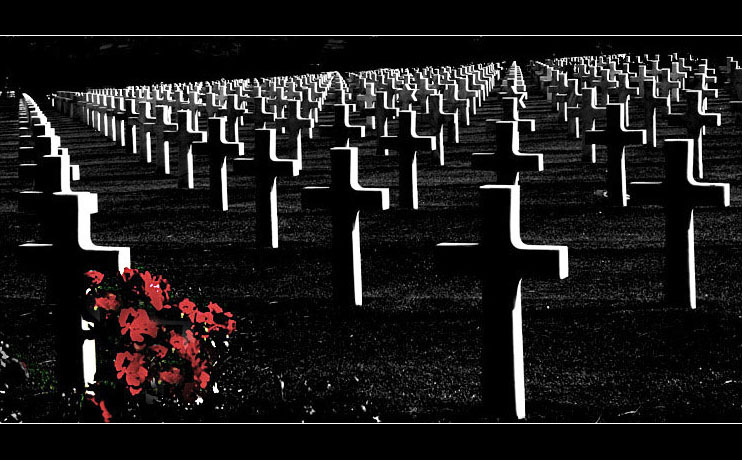
Non, cette photo n'a pas été prise ce 6 Juin. J'ai fouiné dans mes archives pour une photo du Cimetère Américain qui soit acceptable. Celle-ci n'est sans doute pas aussi frappante que celle publiée en Novembre dernier, mais je l'aime bien aussi,
-------------------------------------------

No, this picture was not taken this June 6. I searched my files for an acceptable photo of the American Cemetery at Normandy. This one is not as moving as the one published last November, but I like it too.

-------------------------------------------

REMARKS BY THE PRESIDENT
AT D-DAY 65TH ANNIVERSARY CEREMONY

Normandy American Cemetery and Memorial
Normandy, France

3:53 P.M. (Local)

THE PRESIDENT: Good afternoon. Thank you, President Sarkozy, Prime Minister Brown, Prime Minister Harper, and Prince Charles for being here today. Thank you to our Secretary of Veterans Affairs, General Eric Shinseki, for making the trip out here to join us. Thanks also to Susan Eisenhower, whose grandfather began this mission 65 years ago with a simple charge: "Ok, let's go." And to a World War II veteran who returned home from this war to serve a proud and distinguished career as a United States Senator and a national leader: Bob Dole. (Applause.)

I'm not the first American President to come and mark this anniversary, and I likely will not be the last. This is an event that has long brought to this coast both heads of state and grateful citizens; veterans and their loved ones; the liberated and their liberators. It's been written about and spoken of and depicted in countless books and films and speeches. And long after our time on this Earth has passed, one word will still bring forth the pride and awe of men and women who will never meet the heroes who sit before us: D-Day.

Why is this? Of all the battles in all the wars across the span of human history, why does this day hold such a revered place in our memory? What is it about the struggle that took place on the sands a few short steps from here that brings us back to remember year after year after year?

Part of it, I think, is the size of the odds that weighed against success. For three centuries, no invader had ever been able to cross the English Channel into Normandy. And it had never been more difficult than in 1944.

That was the year that Hitler ordered his top field marshal to fortify the Atlantic Wall against a seaborne invasion. From the tip of Norway to southern France, the Nazis lined steep cliffs with machine guns and artillery. Low-lying areas were flooded to block passage. Sharpened poles awaited paratroopers. Mines were laid on the beaches and beneath the water. And by the time of the invasion, half a million Germans waited for the Allies along the coast between Holland and northern France.

At dawn on June 6th, the Allies came. The best chance for victory had been for the British Royal Air Corps to take out the guns on the cliffs while airborne divisions parachuted behind enemy lines. But all did not go according to plan. Paratroopers landed miles from their mark, while the fog and clouds prevented Allied planes from destroying the guns on the cliffs. So when the ships landed here at Omaha, an unimaginable hell rained down on the men inside. Many never made it out of the boats.

And yet, despite all of this, one by one, the Allied forces made their way to shore -- here, and at Utah and Juno; Gold and Sword. They were American, British, and Canadian. Soon, the paratroopers found each other and fought their way back. The Rangers scaled the cliffs. And by the end of the day, against all odds, the ground on which we stand was free once more.

The sheer improbability of this victory is part of what makes D-Day so memorable. It also arises from the clarity of purpose with which this war was waged.

We live in a world of competing beliefs and claims about what is true. It's a world of varied religions and cultures and forms of government. In such a world, it's all too rare for a struggle to emerge that speaks to something universal about humanity.

The Second World War did that. No man who shed blood or lost a brother would say that war is good. But all know that this war was essential. For what we faced in Nazi totalitarianism was not just a battle of competing interests. It was a competing vision of humanity. Nazi ideology sought to subjugate and humiliate and exterminate. It perpetrated murder on a massive scale, fueled by a hatred of those who were deemed different and therefore inferior. It was evil.

The nations that joined together to defeat Hitler's Reich were not perfect. They had made their share of mistakes, had not always agreed with one another on every issue. But whatever God we prayed to, whatever our differences, we knew that the evil we faced had to be stopped. Citizens of all faiths and of no faith came to believe that we could not remain as bystanders to the savage perpetration of death and destruction. And so we joined and sent our sons to fight and often die so that men and women they never met might know what it is to be free.

In America, it was an endeavor that inspired a nation to action. A President who asked his country to pray on D-Day also asked its citizens to serve and sacrifice to make the invasion possible. On farms and in factories, millions of men and women worked three shifts a day, month after month, year after year. Trucks and tanks came from plants in Michigan and Indiana, New York and Illinois. Bombers and fighter planes rolled off assembly lines in Ohio and Kansas, where my grandmother did her part as an inspector. Shipyards on both coasts produced the largest fleet in history, including the landing craft from New Orleans that eventually made it here to Omaha.

But despite all the years of planning and preparation, despite the inspiration of our leaders, the skill of our generals, the strength of our firepower and the unyielding support from our home front, the outcome of the entire struggle would ultimately rest on the success of one day in June.

Lyndon Johnson once said that there are certain moments when "¼history and fate meet at a single time in a single place to shape a turning point in man's unending search for freedom."

D-Day was such a moment. One newspaper noted that "we have come to the hour for which we were born." Had the Allies failed here, Hitler's occupation of this continent might have continued indefinitely. Instead, victory here secured a foothold in France. It opened a path to Berlin. It made possible the achievements that followed the liberation of Europe: the Marshall Plan, the NATO alliance, the shared prosperity and security that flowed from each.

It was unknowable then, but so much of the progress that would define the 20th century, on both sides of the Atlantic, came down to the battle for a slice of beach only six miles long and two miles wide.

More particularly, it came down to the men who landed here -- those who now rest in this place for eternity, and those who are with us here today. Perhaps more than any other reason, you, the veterans of that landing, are why we still remember what happened on D-Day. You're why we keep coming back.

For you remind us that in the end, human destiny is not determined by forces beyond our control. You remind us that our future is not shaped by mere chance or circumstance. Our history has always been the sum total of the choices made and the actions taken by each individual man and woman. It has always been up to us.

You could have done what Hitler believed you would do when you arrived here. In the face of a merciless assault from these cliffs, you could have idled the boats offshore. Amid a barrage of tracer bullets that lit the night sky, you could have stayed in those planes. You could have hid in the hedgerows or waited behind the seawall. You could have done only what was necessary to ensure your own survival.

But that's not what you did. That's not the story you told on D-Day. Your story was written by men like Zane Schlemmer of the 82nd Airborne, who parachuted into a dark marsh, far from his objective and his men. Lost and alone, he still managed to fight his way through the gunfire and help liberate the town in which he landed -- a town where a street now bears his name.

It's a story written by men like Anthony Ruggiero, an Army Ranger who saw half the men on his landing craft drown when it was hit by shellfire just a thousand yards off this beach. He spent three hours in freezing water, and was one of only 90 Rangers to survive out of the 225 who were sent to scale the cliffs.

And it's a story written by so many who are no longer with us, like Carlton Barrett. Private Barrett was only supposed to serve as a guide for the 1st Infantry Division, but he instead became one of its heroes. After wading ashore in neck-deep water, he returned to the water again and again and again to save his wounded and drowning comrades. And under the heaviest possible enemy fire, he carried them to safety. He carried them in his own arms.

This is the story of the Allied victory. It's the legend of units like Easy Company and the All-American 82nd. It's the tale of the British people, whose courage during the Blitz forced Hitler to call off the invasion of England; the Canadians, who came even though they were never attacked; the Russians, who sustained some of the war's heaviest casualties on the Eastern front; and all those French men and women who would rather have died resisting tyranny than lived within its grasp.

It is the memories that have been passed on to so many of us about the service or sacrifice of a friend or relative. For me, it is my grandfather, Stanley Dunham, who arrived on this beach six weeks after D-Day and marched across Europe in Patton's Army. And it is my great uncle who was part of the first American division to reach and liberate a Nazi concentration camp. His name is Charles Payne, and I'm so proud that he's with us here today.

I know this trip doesn't get any easier as the years pass, but for those of you who make it, there's nothing that could keep you away. One such veteran, a man named Jim Norene, was a member of the 502nd Parachute Infantry Division of the 101st Airborne. Last night, after visiting this cemetery for one last time, he passed away in his sleep. Jim was gravely ill when he left his home, and he knew that he might not return. But just as he did 65 years ago, he came anyway. May he now rest in peace with the boys he once bled with, and may his family always find solace in the heroism he showed here.

In the end, Jim Norene came back to Normandy for the same reason we all come back. He came for the reason articulated by Howard Huebner, another former paratrooper who is here with us today. When asked why he made the trip, Howard said, "It's important that we tell our stories. It doesn't have to be something big¼just a little story about what happened -- so people don't forget."

So people don't forget.

Friends and veterans, we cannot forget. What we must not forget is that D-Day was a time and a place where the bravery and the selflessness of a few was able to change the course of an entire century. At an hour of maximum danger, amid the bleakest of circumstances, men who thought themselves ordinary found within themselves the ability to do something extraordinary. They fought for their moms and sweethearts back home, for the fellow warriors they came to know as brothers. And they fought out of a simple sense of duty -- a duty sustained by the same ideals for which their countrymen had once fought and bled for over two centuries.

That is the story of Normandy -- but also the story of America; of the Minutemen who gathered on a green in Lexington; of the Union boys from Maine who repelled a charge at Gettysburg; of the men who gave their last full measure of devotion at Inchon and Khe San; of all the young men and women whose valor and goodness still carry forward this legacy of service and sacrifice. It's a story that has never come easy, but one that always gives us hope. For as we face down the hardships and struggles of our time, and arrive at that hour for which we were born, we cannot help but draw strength from those moments in history when the best among us were somehow able to swallow their fears and secure a beachhead on an unforgiving shore.

To those men who achieved that victory 65 years ago, we thank you for your service. May God bless you, and may God bless the memory of all those who rest here. (Applause.)


END 4:09 P.M. (Local)

3 juin 2009

Omaha Beach: 65e Anniversaire du Débarquement / 65th Anniversary of D-Day


<< précédente      suivante >>

La plage de Colleville-sur-Mer, juste en dessous du Cimetière Américain, prise de St-Laurent par un beau jour de Septembre.
----------------

Extraits d'articles récents de Ouest-France:

Le président des États-Unis arrivera au cimetière de Colleville-sur-Mer le 6 juin, en début d'après-midi. Une visite historique qui durera deux heures.

« Nous partagerons un moment, sur les plages, a expliqué Nicolas Sarkozy, président de la République. Nous irons nous recueillir dans ces cimetières où il y a tant de jeunes Américains qui ont payé de leur vie la liberté pour notre pays ».

« Cette visite, certes très attendue et prestigieuse, nous oblige à revoir pas mal de choses. » Comme d'autres élus du Bessin, Patrick Thomines, le maire de Colleville-sur-Mer se réjouit de la visite de Barack Obama et de Nicolas Sarkozy, le 6 juin prochain. « Nous n'osions pas avancer de dates et d'horaires précis pour nos cérémonies et pour les manifestations populaires prévues à Omaha Beach. La venue des deux chefs d'États au cimetière américain va remettre en cause toute notre organisation. »

L'horaire de cette visite officielle est fixé à 14h30. « Les deux présidents devraient rester deux heures sur place, estime Patrick Thomines. Mais la quasi-totalité du littoral sera interdite à la circulation durant une bonne partie de la matinée. »

« On m'interroge pour obtenir des invitations ou des laissez-passer, reconnaît le maire de Colleville-sur-Mer. Les habitants me demandent s'ils pourront circuler ce jour-là. » Claudine et Maurice, qui habitent face à la mer sont formels. « Le 6 juin, nous resterons enfermés chez nous toute la journée. » Le couple de retraités reste philosophe. « Après tout, on voit mieux ce qui se passe à la télé. »

-------------------------------------------------------------------


The beach of Colleville-sur-Mer, just below the American Cemetery, from St-Laurent on a beautiful September day.
----------------

Excerpts from articles published in the Ouest-France newspaper:

The président of the United States is scheduled to arrive at the American Cemetery in Colleville-sur-Mer early in the afternoon on June 6. The historical visit will last two hours.

« We'll share a moment on the beaches, explained Nicolas Sarkozy, President of the French Republic. We will bow our heads in the cemetery where so many young Americans who gave their lives for the freedom of our country are buried ».

« This visit, which we wished for and which is most welcome, forces us to revise our plans. » Like most elected officials of the region, Patrick Thomines, mayor of Colleville-sur-Mer is happy that Barack Obama and Nicolas Sarkozy will be coming on June 6. « We waited before publishing official shedules for our ceremonies and for the events planned at Omaha Beach. The visit of the two heads of state at the American Cemetery changes completely the organization of that day. »

The schedule for the visit is set for 2:30 pm. « The two présidents should stay two hours on the site, believes Patrick Thomines. But all traffic will be forbidden along most of the coast for a good part of the morning. »

« I get queries for invitations and passes, acknowledges the mayor of Colleville-sur-Mer. My constituents are wondering if they will be able to drive around. » Claudine and Maurice, who live on the seafront, are already convinced that « on June 6, we will stay inside the house all day. » The retired couple is philosophical about it. « After all, we can see what's going on much better on TV. »

23 février 2009

Colleville-sur-Mer: La Plage, déserte


<< précédente      suivante >>

Il n'y avait personne sur la plage, ce jour de fin Septembre. Des kilomètres de sable fin, un beau soleil, un air pur, et c'était tout à nous.
-----------------------------------------

Les communes de Vierville, Saint-Laurent et Colleville sont entrées dans l'histoire un matin de Juin 1944, mais leur histoire remonte beaucoup plus loin.

Colleville-sur-mer a des origines scandinaves: Un certain Kolil s'attribua un domaine sur la côte du Bessin. On trouve une mention de "Colevilla" en 1082 et de "Collevilla" en 1269.
Il existait un château fort, situé au nord de l'église, le Château Perrey du Moustier. Il fut rasé par les Anglais pendant la Guerre de Cent Ans. On a trouvé dans les terres de labour qui l'avoisinent des bombardes ainsi qu'un jeton frappé en 1451 en mémoire et "en jouissance" de l'expulsion des anglais de notre sol.

Un château est construit au XVIIIème siècle par le Comte de Marguerye. Cette vieille famille noble, mentionnée dès le Xlème siècle, est originaire de la région de Bayeux. Elle s'installe par la suite en Lorraine et en Espagne. Gille de Marguerye, sieur de Colleville, épousa en 1543 Marie Onfroy, fille de Marin Onfroy, Sieur de Saint Laurent sur mer. Ce dernier rapporta de la Biscaye en Espagne, au début du XVIème siècle, une pomme qui fut baptisée "Marin Onfroy". Il cultive cette pomme à cidre, douce et tardive, sur ses terres, puis il la répandit dans toute la Normandie.

Aujourd'hui, elle entre dans la composition du cidre de Véronique, Michel, et Philippe Legallois à la Ferme de la Sapinière à Colleville.


---------------------------------------------------------

There was not a soul on the beach, on this fine September day. Miles of fine sand, beautiful sunshine, pure air, and it was all ours.
-----------------------------------------

The towns of Vierville, Saint-Laurent and Colleville entered history on a bleak morning in June 1944. But their history goes back much further.

Colleville-sur-mer has scandinavian roots: A Viking chief, Kolil, took over this part of the Bessin. Early manuscripts mention "Colevilla" in 1082 and "Collevilla" in 1269.
There was a castle in the Middle-Ages, just to the north of the church, the Château Perrey du Moustier. It was destroyed by the English during the Hundred years War. In the fields next to the castle ruins, some guns were found, along with a coin minted in 1451, in memory of the defeat of the English in Normandy.

A new château was built in the 18th century by Count de Marguerye. This ancient noble family, mentioned as early as the 11th century, has its roots in the region of Bayeux. The family later settled in Lorraine and in Spain. Gille de Marguerye, sieur de Colleville, married in 1543 Marie Onfroy, daughter of Marin Onfroy, Sieur de Saint Laurent sur mer. Marin Onfroy brought back from Spain, at the beginning of the 16th century, an apple that bears his name. It was a late crop, sweet apple, and made a very good cider. Soon it was cultivated all over Normandy.

Today, you can still find it in the delicious cider of Véronique, Michel, and Philippe Legallois àt the Ferme de la Sapinière in Colleville.

30 janvier 2009

Omaha Beach: Que faisais-tu, Grand-Père, pendant la Guerre?


<< précédente      suivante >>

Une petite fille en culotte rouge se promenait avec son grand-père sur la plage à Omaha Beach. Ils se sont arrêtés à côté de la scuplture "Les Braves".
Qu'est-ce qu'elle lui a demandé, à son grand-père?
------------------------------------------------

"Les Braves", qui honore la mémoire des 3 000 soldats tombés sur la plage d'Omaha Beach le jour du Débarquement, est l'oeuvre de l'artiste Anilore Banon. Située sur la plage, la sculpture est donc sur le domaine inaliénable de l'État. Et la loi interdit toute construction en bord de mer.
En 2004, lors de son installation pour le 60e anniversaire du Débarquement, l'État avait accordé « une autorisation temporaire d'occupation du domaine public maritime». Les statues auraient alors dû quitter la plage à l'automne 2004. Mais le maire de l'époque, Raymond Mouquet, puis son successeur, Catherine Chartier, plaident « le devoir de mémoire », et obtiennent un sursis.

Au printemps dernier, l'État prolongea l'autorisation temporaire d'occupation « jusqu'aux cérémonies du 65e anniversaire ».

Pour en savoir plus sur cette sculpture et sur Anilore Banon, allez voir ce site.

---------------------------------------------------------


A little girl in red pants was walking on the beach with her grand-father at Omaha Beach. They stopped by the sculpture of "The Braves".
What did she ask him?
What did you do during the war, Grandpa?

------------------------------------------------

"The Braves" was commissionned for the 60th Anniversary of D-Day in 2004 from artist Anilore Banon to honor the 3,000 men who fell on Omaha Beach on D-Day. Erected right on the beach, it is undeniably within the state's domain. And the law prohibits any construction along the shore.
In 2004, the government had granted a temporary waiver, and the sculptures were to have been removed that fall. Mr. Raymond Mouquet who was then mayor, and Mrs. Catherine Chartier, his successor, both pleaded a "duty of remembrance" and obtained a delay.
Last spring, the "temporary" authorization was extended until after the 65th Anniversary ceremonies.

To find out more about "the Braves" and Anilore Banon, visit this site (in French ).

7 janvier 2009

Les falaises à Omaha Beach


<< précédente      suivante >>


A l'ouest de la plage de Vierville, les falaises tombent brusquement dans la mer.
Les matins d'été, par temps clair, le soleil se lève sur la mer et frappe de plein fouet les falaises d'Omaha beach. Et les mares d'eau abandonnées par la marée descendante en donnent une image double.
---------------------------------------

A 30 ans, Sid Salomon survécut le Débarquement en Normandie.

En Octobre 2003, Sid participait encore à des courses d'aviron sur la Schuylkill à Philadelphie. Il gagna même une course contre un huit de jeunes gens. L'âge moyen de son équipe était de 79 ans!

Mais, maintenant âgé de 90 ans, Sid luttait contre le cancer.

Sid Salomon se porta volontaire dans l'armée américaine après Pearl Harbor. Le 6 Juin 1944, il était 1er lieutenant de la Compagnie C, 2e Bataillon de Rangers. Bien que l'assaut de la Pointe du Hoc par la Compagnie D reçut toute la gloire, les Rangers de la Compagnie C furent les premiers à établir une tête de pont sur le sol français. Avec leurs bayonettes et leurs mains nues, les Rangers de Sid Salomon ont escaladé les falaises de la Pointe de la Percé sur le flanc droit de la plage de Débarquement, ayant traversé la plage avec leurs 30 kgs d'équipement et de munitions. Bien que 35 des 37 homes furent blessés, il s'emparèrent des emplacements de mortiers allemands au sommet des falaises.

"Les blessés avançaient comme ils pouvaient, certains avec un regard plein de désespoir sur leurs visages torturés de douleur," Sid dira plus tard. "Tant que vous n'avez pas vu la mort violente, votre vie semble bien protégée".

Sid revenait en Normandie pour tous les principaux anniversaires du Débarquement. Il aimait amener les familles des vétérans au pied des falaises à Omaha Beach, et leur raconter son histoire de cette journée fatidique. Cette histoire inspira les scènes de bataille du film de Steven Spielberg, "Il faut sauver le soldat Ryan". Son héroïsme pendant la guerre, puis son énergie et sa vigueur qui durent jusqu'à la fin de sa vie, lui ont gagné une grande réputation. Pour ceux qui le connaissaient, c'était "L'Homme de Fer".

Il est mort en Janvier 2004.

-------------------------------------------------------------


West of the beach at Vierville, the cliffs fall precipitously into the sea.
On summer mornings, when the weather is clear, the sun rises from the sea and splashes on the cliffs of Omaha Beach. And the puddles left by the receding tidegive a mirror image.
---------------------------------------

At age 30, Sid Salomon survived D-Day.

In October 2003, Sid was still in rowing competitions at Boathouse Row in Philadelphia, even winning a race against an 8-oar shell of teenagers. The average age of Salomon's team was 79.

But then, now 90, Sid Salomon was fighting his last battle with cancer.

Sid Salomon volunteered to serve in the military after Pearl Harbor. On June 6, 1944, he was 1st lieutenant for C Company, U.S. 2d Ranger Battalion. Although D Company's assault on Pointe du Hoc became famous, C Company was the first U.S. unit to reach high ground. Using toeholds, fingernails, and bayonets, Salomon's group climbed the cliffs at Pointe-de-la-Percee, on the right flank of Omaha Beach, after crossing the beach with 68 pounds of weapons and equipment. Although most were wounded, the group seized control of mortar emplacements at the top of the cliffs.

"Some of the wounded were crawling as best they could, some with a look of despair and bewilderment on their tortured and pain-racked faces," Salomon said later . "Until you see violent death, your life is pretty much protected."

Sid came back to Normandy for every major anniversary of D-Day. He would bring veterans' families to the foot of the cliffs at Omaha Beach, and tell his story of that fateful day. His firsthand accounts provided much of the inspiration for the battle scenes in Steven Spielberg's film Saving Private Ryan. His wartime heroics, as well as his energy and vigor that lasted up until his death, have earned him a larger-than-life reputation. He was The Iron Man.

He died in January 2004.